
Opportunity
Operational Cost Savings
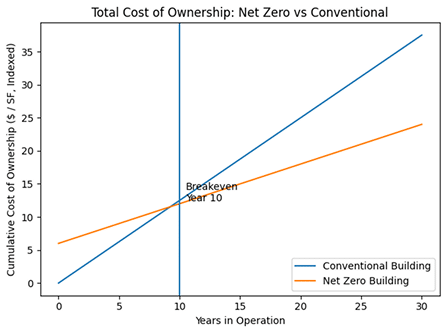
Implementing energy-efficient building systems, on-site renewable energy generation, and passive natural heating and cooling strategies delivers meaningful and recurring operating cost savings. Net Zero resorts dramatically reduce exposure to volatile utility pricing while lowering baseline energy consumption across all operational functions. Targeting a 100% reduction in electrical utility costs in the highest-cost energy market in the U.S. Net Zero properties indicates that operational efficiency improvements alone can generate annual energy savings in excess of $150,800 per hotel, with Net Zero properties often outperforming conventional assets by an even wider margin. These reductions flow directly to the bottom line, enhancing net operating income, improving long-term asset resilience, and increasing overall valuation through structurally lower operating expenses.


Traveler Preference for
Eco-Friendly vs.
Standard Resorts
%
Travelers who say sustainability is important when planning a trip
%
Travelers who want to travel more sustainably in the next 12 months
%
Travelers more likely to choose an accommodation labeled as sustainable/eco-friendly
%
Travelers who prefer to stay at a hotel that applies sustainable practices
Enhanced Market Appeal
Today’s travelers are increasingly eco-conscious, with sustainability now playing a decisive role in accommodation selection. According to recent global travel surveys, more than 70% of travelers say they are more likely to book lodging that demonstrates a commitment to environmental sustainability, and a majority report being willing to pay a premium for properties that align with their values. This shift in consumer behavior translates directly into measurable financial benefits for operators, including higher occupancy rates, stronger brand loyalty, and the ability to command premium room pricing. As sustainability becomes a baseline expectation rather than a differentiator, environmentally responsible resorts, such as Coco Palms, are positioned to outperform conventional properties across both demand resilience and long-term asset value.
Access to Incentives
As a fully Net Zero resort, the project is uniquely positioned to capitalize on a wide range of federal, state, and institutional incentives designed to accelerate sustainable development. These programs—including investment tax credits, accelerated depreciation, and energy-efficiency grants—can materially offset upfront capital expenditures while enhancing overall project returns. In the United States, renewable energy and energy-efficiency incentives can cover up to 30% of qualifying project costs, significantly reducing net equity requirements and shortening payback periods. When combined with long-term operating cost savings, these incentives materially improve cash flow, increase internal rates of return, and strengthen the resort’s financial resilience over its lifecycle.
Federal Policy
↓
Lower Project Risk
↓
Institutional Capital
↓
Scale & Replication
↓
Lower Costs + Higher Returns
Risk Mitigation and Future-Proofing
Adopting Net Zero practices positions the resort ahead of evolving environmental regulations, reducing potential compliance costs and mitigating risks associated with future policy changes. Additionally, energy-efficient buildings are more resilient to energy price volatility, ensuring more predictable operating costs.
In summary, transitioning Coco Palms Resort to a Net Zero model not only underscores a commitment to environmental responsibility but also offers tangible financial benefits, enhances market competitiveness, and ensures long-term operational resilience.